

by Johannes Wolters
Die deutsche Version des Interview – hier anklicken!
Hisko Hulsing, born in Amsterdam in 1971, is arguably the most famous Dutch animation film director today. The multi-talented artist not only directs but also writes, paints, and animates,composes and arranges the music for man odfhis own films.
After graduating from the Willem de Kooning Academy in Rotterdam in 1995, his two short films, Seventeen (2004) and Junkyard (2012), caused a sensation in the animation world. In 2015, he and his team contributed the animation segments to the Kurt Cobain documentary „Cobain: Montage of Heck,“ directed by Brett Morgen. The documentary was acclaimed worldwide and received seven Emmy nominations. Hulsing’s work has become known to a wide audience through the Amazon Prime streaming series Undone (2019) and the episode „A Dream of a Thousand Cats“ (2022) for the Netflix series The Sandman; both projects were nominated for an Annie Award.
Hisko Hulsing’s latest work, the short film „Danse Macabre,“ which will have its world premiere at the Annecy International Animated Film Festival at the end of June, is a stunning visual exploration of Dmitri Shostakovich’s Allegro from his 10th Symphony. The short film is based on approximately 79 of Hulsing’s original oil paintings, which were brought to life over 11 years in an elaborate and innovative concept by an international team of artists from the Netherlands, France, Belgium, Hungary, and South Africa.
The film will be available on Arte’s media library on June 25 and will be broadcast linearly on the night of June 26 as part of the magazine Kurzschluss.
Interviewer: Johannes Wolters
For the record, for everybody reading this, I personally think your film is a masterpiece. You had me glued to the screen for all its five minutes. It’s simply great. I am not so much interested at the moment in the technique, which is certainly groundbreaking. I do not want to know how you did the movie. I would like to know why you did the movie?.
Hisko Hulsing: But I am also happy to talk about techniques. But regarding the „why“: this film is really, I mean, with all the efforts going into creating the content of the film, I think it is about the resurrection of fascism, I would say, which is happening all over the world right now.
I’m really fond of animation, whe animation connects with music, in a way that really clicks. And this is it. It is like Shostakovich told you, hey, do a five minute short about the rise of fascism, because I had that in mind.
Hisko Hulsing: I think the film is more about Stalin, actually about Shostakovich’s life in the Stalin era. So using the word fascism… maybe I should not do that so much, because it is too narrow, it has more to do with the militarization of society, like what has been happening for the last 11 years in Russia. So when I rewatched the moving storyboard that I made 11 years ago, I noticed that I did not change any shots. It’s still the same, even though all the film funds wanted me to change it, because they thought I was promoting war. I was like, what are you talking about?
Watch the Animatic of „Danse Macabre“ from 2017
Interesting point. If you do an anti-war film, you can easily make it into a pro-war film.
Hisko Hulsing: I think that not a lot of people will understand that. Anyway, 11 years ago, Russia took in the Crimea from Ukraine. And there were already these things going on in Donetsk. And I was a bit confused, I found it strange that everybody was so silent. The whole European Union didn’t really act – they found ways to react, like Republicans do after a shoolshooting, the „thoughts and prayers“ stuff. You know what I mean? I found this weird. No real action from other European countries. And at the same time, I was following what was happening under Putin. And that, to me, seemed like a form of fascism. He was talking about making, – what Trump later repeated -, making Russia great again, he was dreaming of a Russian empire like in the old days. They were planning to build huge statues of Vladimir, some warlord from the 15th century, reviving all these demons from the past – that are demons for us, but that are heroes for them. And I thought, well, that is interesting, you can see it happen in real time, how they’re building up this whole military thing whith which they’d like to occupy other countries and suppress their own people. The I saw how the Russians interfered with a referendum in the Netherlands about a treaty between the EU and Ukraine. We were actually already noticing it here in the netherlands very early, how the Russians were infiltrating western democracies. And then, of course, you had the Brexit. Since then we have seen a rise of rightwing extremism and autocratic regimes and openly fascist parties all over the world.
True!
Hisko Hulsing: Anyhow, so Shostakovich, he was living like in the late 30s, during the Great Terror. Millions of Russians got deported, locked up, killed under Stalin. And Shostakovich, he used to lay in his bed every night, fully clothed, with his suitcase next to his bed, with all his stuff in it.

Because he was convinced that he would be arrested and deported, just like many of his artist friends. And during that time, a little bit earlier, he wrote the Fourth Symphony, which was never performed, because it was too avant-garde. So, his Fifth Symphony had as the undertitle, „An Answer to the Just Criticism of the Party of the People“.
So, why I’m telling this is: because he always had to walk this thin line between being the Soviet hero or being killed. That’s kind of a difficult position to be in. But if you listen to his music, you can hear that in everything he made. You can hear the very, very dark undertones. But you can also hear things that are almost like propaganda, like the Seventh Symphony, that is about Leningrad fighting the Nazis. So, there is always this ambiguity, I would say, between darkness and euphoria and a lot of other emotions. And this particular piece, – he wrote it just after the death of Stalin – a lot of people think that this four and a half minute piece of music is a terrifying portrait of Stalin. I am not so sure about that. But I think what you can hear in the music is the combination, this ambiguity is already in there. You hear panic, you hear fear, you hear terror. But you also hear excitement. It’s also a kind of pushing things. It is very, I wouldn’t say euphoric, but it does, you know what I mean? I have to find the right word.
There’s something attractive in that!
Hisko Hulsing: Exactly! The music seems to drawn us towards something…. I use that in my film. In the film there are musicians, like the muses, who are leading this dark army to some kind of light. I have done that in a cynical way, everyone will feel that this is a false light and that the muses have dark intentions. I’m using the music as an element within the film. The music is leading the troops to some horrible destination.
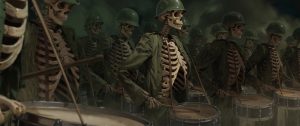
So, you have the drummers, you have the violin players. They are all part of that music. The way the film is structured is that this dead soldier or sleeping soldier is brought to life by the music actually, by those muses. And while he is coming to life, he turns into a skeleton right away. So, once the soldier is coming to life, he is a skeleton already. I mean, the soldiers who are now being sent to the front in Ukraine, the Russian soldiers, they are dead the moment they are leaving. They have still a couple of days to live. They are already dead.
And I am following the music of Shostakovich, the first part feels very militaristic, but organised. It is very orderly. I treated the first couple of shots as if filmed by Leni Riefenstahl. And then, then you have the marches. They are very orderly. But, of course, ultimately everything descends into chaos. First, this army of death starta attacking humanity as a whole, killing everybody. And then it turns into absolute chaos, the soldiers start dancing drunk over bodies of people and they hang their own muses. Because that is also what seems to happen in most wars. It might start off with ideologies and all kinds of higher ends, but in the end, it’s just like, what the fuck, you know. Let’s just kill everybody.
Like Shakespeare said: „ Let slip the dogs of war“ – the atrocities of war that are inevitable.
Hisko Hulsing: Yes, indeed. And I think most wars end up in anarchy. And when people are in an anarchistic state, the worst things happen because they want to survive and they just become beasts. That is describing the film in a simplistic way. I mean, there is a lot of other things. But I have to be careful not to explain the film too much, because there is a lot of layers in there that I want people to find out for themselves.
For me, it was like, you show us a side of ourselves, of the human condition, that we avoid to look at, that we are all able to go to war very easily. And we do not want to face the music, so to speak. We all have that in us and it needs to be tamed. It needs to be educated. It needs to be, simply, it needs to be avoided.
Hisko Hulsing: That’s true. Absolutely, I agree. But promoting the film as an anti-war film would be too simplistic. I think that Ukraine has the right to defend themselves to Russia. They should defend themselves, in my opinion. Yeah. But that is quite different from the motives of countries like Russia, who have no real reason to invade that country, other than reviving their old Russian empire. That is a different kind of motivation. So, I am supporting the Ukrainians. The film is really about the way people are being sort of drawn into a way of thinking that leads them to believe that they have to invade other countries, that are being seen as inferior, in glory of their fatherland. And I think, I mean, I don’t know your age, I’m 54. I’ve been very lucky of having lived without any war in my life, you know.
Yeah, me too.
Hisko Hulsing: Yeah. So, that is good. But once there is a similar situation here, I do not know how I will behave in such a situation. I have no idea.
I had two parents who had to deal with World War II at a very young age. They taught me about war and that I should do everything to help not to let it happen again.
Hisko Hulsing: Well, that is a very German thing. I think that the Germans are almost overly correcting the faults of their grandparents and parents and became almost… I mean, I love itr. That is why I love Germany so much. There is so much guilt about what happened. Even by people who were born 40 years afterwards, which is somehow a shame, because what was their role apart from not being born yet? But in a way, it is good that the Germans are so aware of the past, that they become so anti-war, you know. But I think it has changed a bit. It has to change in the cuuernt situation with Russian threatening its neighbours.
Well, at the moment, I think many Germans have forgotten about it.
Hisko Hulsing: And there are parties now on the rise like the AFD.
I would have loved that we would live in a time that when your film would have come out, everybody would have said, yes, we know, we are all against war. Another anti-war film, so what? But now in our modern day reality your film hits the zeitgeist on the nose and comes at the right time.
Hisko Hulsing: That is true but that is pure coincidence. And I actually took out some stuff from the film in the last half year because the times changed. I was always looking at the right wing people as sort of closet fascists. They were not really openly about it. But the times have changed. People are openly… I mean, like Elon Musk giving the Hitler salute. That is being openly fascist. I mean, he says he did not do it, but we all saw it. He did it twice, you know. So he is openly fascist. That is why I took out some stuff in the beginning. In the opening shot with the millions of violin players, there used to be those bowls on top of the stage with all the fires, as with the Olympic Games in 1936 in Nazi Germany. I took things like that out, because I thought, no, this is too on the nose. I mean, it has to evoke those images, but it cannot really be like a „Triumph des Willens“. So I took it out because suddenly I realized that now there are people who like that kind of shit. I made it more universal, actually.

There’s a very famous Disney short film from the 1940s.
Hisko Hulsing: Donald Duck? You mean the Donald Duck one? That’s very funny.
There’s another one: „Education for Death“, a Silly Symphony from 1943, it’s a not very typical Disney, its a „Why we fight“ film and also an anti-war film, where we see how the Germans are getting ready to march to the sound of music into a big grave.
Hisko Hulsing: Oh, that’s interesting.
It is a film very much hidden by Disney because it’s really taking a point and saying Nazis are bad people and the way they make German soldiers forget about free thinking and just march into war and therefore marching into death. It’s a brilliant short film and I was very much reminded of it when I saw your film. You should see that.
Hisko Hulsing: I never saw it. Why are they hiding it then?
Many reasons, it is so dark. It’s really dark for a company that is selling joy, sunshine, laughter and things like that. It was done for a very special purpose to show the Americans that the Germans are now the enemy and they had to deal with them. And that’s a interesting thing, because the Second World War is almost something like a „just“ war. It’s a war you can defend. It would be tough to make an anti-war film about the second World War- You have to fight it because of the agression and the atrocities we Germans did there, it was/is neccessary to fight the Nazis. The other big war, the First World War, is on the other hand a war that is almost incomprehensible. And you can’t understand it if you look at it closer because so many people die for nothing.
Hisko Hulsing: Yeah. It is like a horrific dream. I was in the north of France 20 years ago. W came into a little forest, and there were a lot of still a lot of holes in the ground from the bombs. And there was a little sign. It said, there was this German general who promised his soldiers that they would take this position in 24 hours. It then took a year, and over 100,000 soldiers were killed on that same field. Cannon fodder. They were brought there from both sides and died, died, died. It’s an apocalyptic nightmare. You know, that is what I call this film. It is not really an anti-war film, it is an apocalyptic nightmare.

And also, I use this term apocalyptic because I use very common imagery from the writers of the apocalypse from the Bible. I am a fourth generation atheist, so I never actually read it. But the problem right now is that there are a lot of people who are actually thinking in an apocalyptic way. So people like Peter Hegseth. I did not know him 11 years ago, but there were other people like him. He thinks that the Middle East is some kind of holy fighting ground for him, that Israel and Palestine should be for the Jews. I know Germans have a different opinion about it, but I have become a fierce critic of the Israeli government.
Well, me too.
Hisko Hulsing: I noticed a lot of Germans are changing their opinion too, but I mean, I understand why they were always so pro-Israel. I was always like, Palestines and Israelians both have their reason to be there. I still do. But right now, I think the Israelis are behaving like fascists actually, to be honest. And now there are also people like Peter Thiel, I think he’s German too.
Yes, you are right.
Hisko Hulsing: He has kind of these apocalyptic ideas. So not Trump himself, but the people around him, some of them. And that is very dangerous because they are almost pushing the end of times, with their weapons of mass destruction, it’s horrible.
When I started making the Moving Storyboard 11 years ago, I was not just listening to the music of Shostakovich. I was also reading philosophy. Books from John F. Gray , who was the humanist way of thinking with apocalyptic thinking. Or Francis Fukuyama, he spoke in the early 90s of the end of communism, the end of history, that was kind of an apocalyptic way of thinking, like, are we all going to this higher goal? And that is not how history works. All those ideas got into this film. Nobody will ever find them out unless I talk about them, but they’re in there. What I mean to say, is that it is not just the religious fanatics who are into this apocalyptic thinking. It is deeply rooted in human civilization to think that their ought to be some goal to history. Some end of times, a clear direction. Instead history is just a sloppy mess of events.
I was thinking about this tragic notion that the survivors of World War I told themselves this is the war that ends all wars.
Hisko Hulsing: Did they say that?
And it took only 20 years to get another one.
Hisko Hulsing:
Hisko Hulsing: This summer I went to, we traveled to Berlin through Eisenach, because Bach, that’s where Bach lived. And my wife’s a musician, my son, too, and we’re all Bach fans. And then we went to Weimar. And I suddenly realized that, the democratic government in Weimar inbetween the two worldwars had such good principles, but they didn’t understand enough about human nature and about how the pop[ulation was experiencing the way they were defeated.
When I showed people the animatic, I’ve showed it to a lot of people – also in Kiev, by the way, four years ago in an IMAX theater – many of them were reminded of World War One.
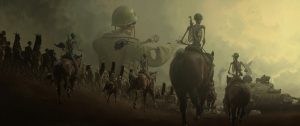
Because I used all these brownish colors, people would always associate it with the First World War. And that could be because me and my brother as children would visit my grandfather who was a communist resistance fighter. And me and my brother, a very good graphic novelist, Milan Hulsing – we would always sit on the ground and study all those illustrated books about the First World War. I think that might have been an inspiration too, like seeing all those works.
Here in Germany our imagery of the First World War, almost everything is coming from „All Quiet on the Western Front“ by Erich Maria Remarque.
Hisko Hulsing: Yeah, I read it a long time ago.
And it’s about living in the trenches and therefore it’s always muddy and brownish.
Hisko Hulsing: Yeah, yeah, yeah. And of course, all the images that are there, are black and white, and the photographs became sepia brownish. I am half Czech, so of course I read the good soldier Svejk from Hasek. And „Journey to the End of the Night“ by Céline. That is also about the First World War. But my film, „Danse Macabre“ is not particularly about the First World War, it’s about war in general. When I was doing the animatic people kept telling me: soldiers are not marching anymore and they use drones. First of all, it’s not true.

Did you ever look up the Chinese propaganda videos on youtube? They have these marches. I mean, it is incredible. They are marching much better than the Nazis, actually. I will not start a competition here (laughing) No, I’m joking. But what I’m saying, it is not gone. You know, the Russians have their parades. Well, they do not have soldiers to march anymore. And the Chinese, they have their parades. The North Koreans. Those parades, the marching, it is also the illusion of being completely in control, being organized. We do not have that in Western Europe because we have terrible associations with that kind of militarism. But it is not gone. It is still there. Trump tried it, but it did not work it out. So it is hard to make such a film. I mean, if I would have used drones in my film, it would be ridiculous because in 20 years there will be something else, you know. And there is the imagery we have from wars through books, monuments and paintings.
In the end, people are dying and people are doing the killing. Even if they fly drones.
Hisko Hulsing: Exactly. It is the best metaphor you could choose. That has always been my point when I communicated with film funds. I said, okay, modern warfare might look different. But in the end, if you compare Gaza to Dresden, you do not see any difference. It is just because both were completely obliterated. After all this destruction , every town looks the same. Just ruins.
That’s also the official meaning of the word Danse Macabre. Death being the big equalizer. It doesn’t matter if you’re rich or poor. In the end, we will all be the same. Dead. And that’s how it is with wars. In the end the suffering is equal, whn you loose your family and friends and everuthing around you is gone.

Have you been influenced by Hieronymus Bosch or Peter Bruegel or artists in this kind of tradition?
Hisko Hulsing: Well, I am a big fan of Bruegel, especially. Bosch too, of course. But he was fucking crazy. That’s such a weird genius. It is really hard to be influenced by somebody like that because it’s so unique. But I have been influenced by many, many artists. And Peter Bruegel is one of my favorite painters. That is correct. And the 17th century Dutch painters and Velazquez. When I made my mood boards for the film funds, I would always name Francisco Goya. I am not a big fan of Goya, but I always named him because he is the first one that was sort of making chronicles about the war with all its atrocities. I used it to convince the film funds thatyou can make art about this subject matter. And of course Fantasia from Disney, this was a big influence because of „Night on Bald Mountain“, and also „Fantasia 2000“. The last segment about the Firebird. I mean, it is a little bit too kitschy for my taste eher and there, but so good overall…..
But the drive and the timing! It is a great short film.
Hisko Hulsing: It is fantastic. It is very well directed by Paul and Gaetan Brizzi from France. I’m sure they are musicians, like me, you know, they have to be. It is so perfectly timed. And then the other film is Pink Floyd, The Wall of course, with the walking hammers. Those films have been very influential when I was young. But when talking about influences, there is so much, you know, I’ve been influenced by music, but mostly by live action films. Roman Polanski is one of my biggest influences, films like The Tenant or Rosemary’s Baby. So it goes on and on and on.A million different sources of inspiration

When I first saw the trailer you put out, I immediately thought, this is so bold, the moment when the guy, the skeleton is galloping through the town. I think it’s really tough to make a film, an anti-war film, without making something attractive about war. There are historic examples where they recut films to change the mood from anti-war films to pro-war films…
Hisko Hulsing: I already saw a TikTok film where they recut scenes from my film and used some kind of hip hop under it. So, that’s a problem. It’s well done, actually. And I’m okay with it. But I have to be careful with that. That’s true. But on the other hand, you know, they are all skeletons. It’s dark, not uplifing. I went to an exhibition two years ago in the Netherlands about fascist art. And I was very glad that I went, because it was clear that the art that the fascists liked and promoted was all about beautiful, strong, healthy men, not about skeletons. The women, they were all there just to make children and do the householding. And it’s a completely different kind of imagery. I mean, the imagery that we have of Second World War and Nazi Germany is not comparable to the imagery they received from their propaganda. We think about concentration camps and mass murdr=ering, while most Nazi art was about glorifying blond Arians. Not a lot of sketons in their imagery.
Yeah, there is a fantastic painting of Hitler as a medieval knight.
Hisko Hulsing: Oh, yeah, exactly.
Yeah. And this backfired to me so much, because when I saw that, I immediately laughed out loud, because it was so funny.
Hisko Hulsing: It’s a caricature already. Yeah, exactly. You can’t make fun of it, because it’s funny in itself.. At this moment, I’m not so worried anymore. I was worried for a long time that people might misinterpret my film. But the thing with that giant monkey soldier in my film that is destroying the whole town, I mean, what I try to tell in that part is that that is the problem with humanity. We are still kind of primates, but we are primates with very developed technologies. And this technology is still developing in an exponential way. But the ethics of humankind are not developing in an exponential way. We are actually getting dumber, as a human species. So that is what I tried to illustrate there, that these soldiers that are being dropped, start running like animals, like monkeys, and then alll end up in a nuclear explosion. There are all those ideas in the film. I am sure that some people will misunderstand some of it. But that is with all art, you know, you can never tell.
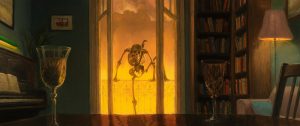
I would like to know how it all, how the kernel of the idea came into your mind 11 years ago. How did you come up with the idea?
Hisko Hulsing: Well, first of all, it was 11 years ago when I started. But in the meantime, I directed Undone, two whole seasons, and I did an animated episode of The Sandman on Netflix.
Which we talked about, this very nice idea that cats are eating humans.
Hisko Hulsing: (laughing) That’s also an interesting thing, I didn’t write it. It’s from Neil Gaiman, but it is sort of up my alley. Well, anyhow. The idea to „Danse Macabre“ started after „Montage of Heck“, the film about Kurt Cobain. I made animated sequences for that. And that film became very big. Kurt Cobain from Nirvana superfamous. It was for Universal Pictures, HBO. It was shown all over the world and got seven Emmy nominations. And there was this rapper called Kid Cudi. He’s a hip hop artist. And he ended up making „Entergalactic“ years later. But at that time, he was not doing very well. He was in a very dark place. But he saw „Montage of Heck“ and he loved it so much that his manager wrote me an email if I was interested in cooperating and if I preferred business class flight to LA or first class. I was like, okay, I can do that. And they put me in a great Hotel at Hollywood Boulevard. I was going to the sound studio every day with Kid Cudi who was recording his new album, to listen to his ideas and see what kind of visuals I could come up with them. And the visuals were very demonic. He was not doing very well. He he got over it. Now he’s very happy and famous. But at that time he was not doing very well. And his ideas were very dark, it was more about his inner demons. In the end we never made that film.

And when I came back in the Netherlands, I thought, well, there’s actually a piece of music that evokes this kind of images with me. And that is the second movement of the 10th Symphony from Shostakovich. I already had those images when I was 20 years old , violins that sound like horses, drums that sounded like explosions. I can listen to music in an abstract way, but I also very easily get images in my mind when listening to certain music. I have read two biographies of Shostakovich and I know quite lot about him and his music. I am a musician, my wife and my son are professional musicians, violinplayers. I saw some early music sheets that Shostakovich wrote when he was 16 or 15. He woud write comments next to his score like: this is where the soldier comes out. He was describing the music in visuals. So I know he also had a very visual mind. I’m pretty sure.. I am sure he was thinking in these kind of ways. I mean, this movement of the 10th symphony is clearly a march. It is a march. You cannot really see it in any different way. And it is also clearly about terror and panic and death and chaos.

So, maybe I use different images then he had in mind, but I do not feel bad about it. And so I started storyboarding. There is nobody on this planet who has heard this piece of music more than I did, I think 2000, probably 3000 times, literally, because I would sit there and just listen to it. And it was a very hard process. I would never make more than two drawings per day, which is not a lot when storyboarding. Usually I to do 10, or sometimes 60 drawings a day. I made many storyboards for other projects. But here, it was different. Because first of all, I wanted to keep on thinking about what I was drawing. And I wanted to keep on thinking about what my story would be about, because I did not have a clear outline for the story. I didn’t have a script, I just started with music. And then while I was drawing storyboards, I was developing my ideas for the whole structure of the film and for the ideas. So that is also why I worked them out pretty well. Because I know, when I do that, it gives me more inspiration than when I make a quick sketch. It is hard to explain, but it is sort of feeding my own brain.
Sorry? This is your way of doing it?
Hisko Hulsing: Yes, feeding my own brain with new inspiration. And then it was very hard to get a structure in the film, because the problem is that it is four and a half minutes. And on Minute 2:10, that is where I already put in the nuclear explosion. So I got there because it does not follow a three act structure, this music doesn’t follow that kind of structure. So the climax, the biggest climax is in the middle. Therefore I was completely stuck for many months, I did not know what to do after that. I had many ideas, but they all proved wrong. Till my producer called me and he said, Hisko, what are you doing, we have to deliver the moving storyboard in two weeks! And suddenly, the whole ending came out of my head. You can compare it to writing a script. But this was purely done with visuals, never in writing, always completely in sync with the music – in my brain, at least. And this had to tell kind of a story.
My first encounter with such a way of storytelling is The Old Mill, again, a silly symphony by Walt Disney from 1937, by the team of Walt Disney. It is „just“ music, it’s an atmospheric thing. If you see it, there seems not much story in it. It is only a night at the Old Mill. And there is a thunderstorm.
Hisko Hulsing: Yeah, I know. Beautiful things happening. It is unbelievable. Beautiful. I think I agree with you. I mean, there is still a lot of good animation today. But I think that the early days, like the Max Fleischer films, and the early Silly Symphonies, the early Disney films, that was when animation was at its highest peak, in my opinion. And you do not have to agree, but that is my opinion.
I have seen your film, I would disagree.
Hisko Hulsing: Haha, okay, thank you. But telling a story with purely images and music, it can be so powerful, especially with animation. You can also do it with live action. Like my film Junkyard , I could have told that story actors,maybe…. But I just enjoy those old Fleischer and Disney films the most where everything has a soul, everything is moving. You can watch them over and over again. Or a film like „Father and Daughter“ from Michael Dudok-De Wit. That is one of my favorites, because it is a story but there is no real, very logical flow to it. So you can watch it over and over again, because every time you see it, you see different things. And that is what I like about, about animation the most. Telling the unspeakable. But you were asking something different.
What was the next step after having finished the storyboard and the animatic?
Hisko Hulsing: Usually, the process is, well, I don’t have to explain it to you. You know: the backgrounds are separate from the characters, of course. And so, for my films, for „Junkyard“, „Seventeen“, and all those films, I made hundreds and hundreds of beautiful paintings as backgrounds. I like them. But the subject (the character) is always missing, it’s always like an empty decor. And I got fed up with it. I know that my paintings are good, but they will always be seen as background paintings, which is kind of a shame. So I thought, let’s just turn it around. Let’s just paint the whole scene. So I started painting them with the characters in them. Every shot started with a painting like that. But I didn’t have any idea how to approach it afterwards. It was a bold move. In a way, I was like, okay, I want it to look like this. I don’t know how, but I’m going to find out. And then we did a test with projection mapping with Polder Animation, which I was pretty happy with in 2017.
2017? You are a very patient man.
Hisko Hulsing: The test was okay, but it would be very expensive. So it was not possible this way. Then I did Undone, two whole seasons and the animated episode of the Sandman. And then after that, UTA started representing me. It’s the biggest talent agency in LA. And they connected me with Netflix, Amazon, Sony, Blur Studios, all those big studios. I couldn’t imagine myself going back to making a short film.
And so I pitched it as an anthology – as a part of an anthology, a Fantasia-like anthology, , Fantasia for adults. So once I started talking about that, some of the studio’s got really enthusiastic. I remember, there was this woman from Netflix and there and she said, „Do you want to do Fantasia? Look behind me“. And there was actually a poster of Fantasia hanging behind her. But when I showed the moving storyboard, I saw the corners of her mouth go down, like, „Oh, this is not what we want to do“, you know. I mean, they didn’t see the commercial potential in it. So nobody wanted to do it. I thought well, I then I have to do this short myself again, which saved the project. I I would have done it as one part in an anthology, it would never had this quality. Because now I was forced to be involved in every detail of the film, you know, so really every drawing goes through my hands to retouch it. And I’m briefing people in a very detailed way. So I could make this film as a short film director, which makes it much better when than when I would have been just some kind of supervisor on the project. There were four countries involved, Netherlands, Belgium, France and Hungary. And even a studio in Africa that was working together with Autour de Minuit, Gao Shan Pictures. And so I would have these weekly zoom calls, briefings where we would discuss every shot. And the starting point for every shot was either the storyboard and the live action recordings that I did, or the painting, depending if the painting was finished or not. So what I’m saying is that this film was helped very much by the fact that it’s a short film. The problem with short films is that there’s never enough money. So I always end up in debt. That’s just part of the game when you make short films. But yeah, it’s worth it. I think, I hope.
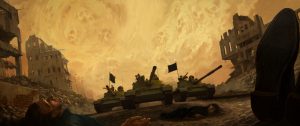
Are you able or allowed to tell me a little bit about the budget? Of course, you can’t be paid for all your time, which you put in as it seems to be a passion project.
Hisko Hulsing: The budget? I can tell you. One of the biggest passion projects I was ever able to lay my eyes on. In the end, of course we had to pay people for making it. So there were four producers. And I can tell you this. The total budget was 470,000 Euros. That is a lot of money.
Really? Only? 470,000.
Hisko Hulsing: Yeah.
It looks much more expensive.
Hisko Hulsing: Oh, really? Thank you. Thank you for that. Well, I have to tell you this. Listen, I am pretty sure that Autour de Minuit did not make any money. There were so many people working on the film. I cannot imagine that they did not put their own money in. My own producer in the Netherlands,Richard Valk I think he is also sort of bringing in part of his fee. The Hungarians did not get any money from the state. That was still during Victor Orbán´s gouvernment, of course. And they put in their own money. It’s all their own money. But it is a passion project for a lot of people, actually, in a way. I know the Hungarians, that was Cinemon Entertainment, Reka Temple . She just was very enthusiastic about the film. She said it’s a very important film and we want to participate in it. And then they put in 25,000 euros of their own money. So it is a passion project on every front, actually. And I mean, all the artists got paid, you know. But I think at some point people realized that it was going to be special and they did their best. And also Stein Louisse, who helped me with the Stable Diffusion ComfyUI, that whole part, he was the only person in this part. And he did not make a lot of money either, because he started developing these new techniques two and a half years ago together with me. And I do not want to know what he got paid, but barely enough, probably. And he was great, it was such a hard process because he had to program all the time, do trial and error over and over and over again. Sometimes I would approve something and then weeks later he would come back and say: „Well, I’m not satisfied. I’m going to try it again“. So that’s very, very uplifting, you want to work with those kinds of people who are just like: „No, it’s not good enough. I have to do it better“. So I was very happy with that.
You must be a great communicator to make people work that way.
Hisko Hulsing: I always think if I would have such a thing in my mind, it’s very tough to communicate and to bring everybody on the same page. Well, I have a lot of experience now because I directed Undone, which was six hours of animation with 200 people working on that. And on „Dream of a thousand Cats“, there were also 150 people working on that. So I got better at it. First of all, people notice right away that I know what I want. And a lot of directors do not know exactly what they want, which makes people insecure. I have made storyboards for over 120 advertising companies as a commercial storyboarder. There’s a balance to be achieved between being very precise, but giving people creative freedom at the same time. If you give that kind of direction, people flourish because they get what is being expected from them. But they also know they can elevate it. And that is what I learned from working for other people: especially older art directors understand this: Give artists certain parameters, and then within those, give them freedom to thrive. And then they flourish, because they feel and know it is also theirs. That is the way I approach people. I give them clear directions and with that a lot of freedom. So they can thrive when they work on it.
Is it hard for you to let it go, to give your brain child to other artists and they enhance it and they bring something to you from that side?
Hisko Hulsing: Well, it is hard when people are not competent. That happens sometimes. And you find out during the process that not everybody is as good, but it’s especially nice when people are elevating it. You never know. It’s kind of an uncertain process. So it is not easy. I try to give as many tools to work with, like reference material, because I filmed the whole film with actors and musicians first, and then I cut it. So the film was cut based on the animatics.

So they already have all that reference. They have a lot of stuff to work with so I’m trying to control it as much and at the same time giving them some freedom. I like people who are pro-active, who just do things that I did not ask for and then: oh wow, I did not think of that. That was so great when I directed Undone. I used to think that the more people work on a project the more it got dumbed down, but that’s not true per se because when you’re on a set with 30 people there’s 30 brains and there’s more than one brain so you get all these inputs and if you know how to use the inputs then you get a better product, a better project. But in the case of my film it is a little bit different because I knew so well what I wanted so I could not give people too much freedom actually.
I personally would give you the academy award just for this the trailer! Very rarely I see something so really new. I was really grateful. I saw the work you put in every frame.
Hisko Hulsing: You see the work yeah but, because we’re connected on social media, you already saw the paintings through the years so that makes a difference too. And if you are interested in the „How we did it“ I made a Making-Of Video that explains the production pipeline en detail.
Danse Macabre
Danse Macabre will be an apocalyptic nightmare, based on the Allegro from Shostakovich’ 10th Symphony.
Written, directed and painted by Hisko Hulsing.
https://www.imdb.com/de/name/nm0401563/
A multimedia project that consists of a short, animated film, a series of oilpaintings and orchestral performances.
Releasedate 2026, duration, 5 minutes
Producers:
Richard Valk, Valk Productions – The Netherlands
Nicolas Schmerkin, Autour de Minuit -France
Viviane Vanfleteren, Vivifilms – Belgium
Reka Temple, Cinemon Entertainment – Hungary